
Introduction
The OECD's transfer pricing guidelines on cash pooling arrangements were introduced in February of 2020 in its publication of "Transfer Pricing Guidance on Financial Transactions". These guidelines were subsequently included under Chapter X, Section C.2 in the 2022 update of the OECD's Transfer Pricing Guidelines for Multinational Enterprises and Tax Administrations. Concurrently, a global post-COVID environment characterised by higher interest rates has increased the tax significance of cash pooling arrangements, as even small adjustments to internal interest rates can materially affect taxable profits.
The OECD's guidance is extensive, so we will boil it down and explain the essentials with regards to cash pooling, while referring to the relevant paragraphs. Best practices and tips to align with these guidelines are discussed. Please note that key terms, such as transfer pricing and cash pooling itself, are covered in our previous publication on Understanding Cash Pool Transfer Pricing.
OECD on Centralised Treasury Functions
The OECD introduces section C on treasury functions by outlining different activities tied to the various degrees of centralisation a multinational's treasury may have. While some multinationals may have entities with a high degree of financial independence, for example due to local regulations, others may wish to fully centralise treasury control to mitigate financial risks and optimise the cost of capital. A highly centralised treasury function can usually be expected to be strongly involved in the group's cash pool, oftentimes performing the totality of a cash pool leader's role. Whereas mere coordinating activities of a treasury are expected to receive an arm's length fee, more complex functions and risks borne warrant corresponding compensation.
Cash Pooling
Section C.2 of the transfer pricing guidelines is dedicated to cash pooling. It starts with an explanation of the two main cash pooling structures, physical and notional, noting that there are variations and hybrids of these structures.
Physical cash pool structures are those in which participants' cash balances are physically transferred to the cash pool master account.
Notional cash pool structures don't require physical transfers between accounts, as the accounts are notionally aggregated and the bank pays or charges interest according to the pool's (notional) net balance.
Identifying Cash Pool Synergies
The savings and efficiencies achieved through cash pooling arise as a result of group synergies created through deliberate collective action. The OECD's guidance for applying the arm's length principle (Chapter 1, Section D.8, paragraph 1.181) states that synergies arising from deliberate concerted group actions may not always have comparable arrangements between unrelated parties. Cash pooling is one of those cases, as it is not normally undertaken between independent companies. Therefore, the OECD Transfer Pricing Guidelines assert that "it is necessary to determine (i) the nature of the advantage or disadvantage, (ii) the amount of the benefit or detriment provided, and (iii) how that benefit or detriment should be divided among members of the MNE group".
The central transfer pricing question is therefore not whether a cash pool creates value—it generally does—but how that additional value should be shared among the cash pool leader and the participating entities under the arm's length principle.
Determining the Nature and Amount of Synergy Benefits
Paragraph 10.121 describes the nature of an advantage of cash pools as the decreased interest costs to its participants overall. We can quantify the amount of this benefit by referencing "the results that the cash pool members would have obtained had they dealt solely with independent enterprises". In essence, the benefit can be found by calculating the difference between interest that pool participants pay and receive within the cash pool and the interest they would have paid on their debit position, or would have received for their credit position, when transacting with an independent party (their standalone interest rates).
Paragraph 10.146 notes that another benefit of a cash pool arrangement may be the easier access to liquidity, as it reduces participants' reliance on external banks for funding. For a practical example of the synergy benefits created by cash pooling, as well as a list of its advantages and disadvantages, see the section on Pros and Cons of Cash Pooling in our previous publication.
For practical purposes, the overall synergy benefit can be viewed as consisting of two components: offsetting synergy, also called netting synergy, and interest synergy.
Netting synergy refers to the benefit that stems from offsetting the credit and debit balances of the cash pool participants.
The interest synergy is the interest received on the net balance of the cash pool. Once the cash pool participants' balances are offset, any remaining balances will incur or accrue interest. The difference between the interest received (or paid) within the cash pool on this remaining balance and what would have been incurred or accrued externally is considered interest synergy.
Dividing the Cash Pool Synergy Benefits
Rewarding the Cash Pool Leader
The cash pool leader should be remunerated for the functions carried out, risks assumed, and assets used in the context of managing the cash pool. An analysis should be performed to understand the extent of the cash pool leader's role. The OECD Transfer Pricing Guidelines assert that the cash pool leader should be rewarded at arm's length before any remaining synergy benefits are distributed to the cash pool participants.
Economically significant risks, such as liquidity and credit risk, associated with the cash pooling arrangement are mentioned by the OECD Transfer Pricing Guidelines in paragraph 10.125. The next two paragraphs expand on this, highlighting that exercising control functions and having the financial capacity to assume the risks would be required in order to allocate said risks to the cash pool leader.
Section C.2.3.1 explains that cash pool leaders oftentimes merely assume a coordination or agency function. This is especially prevalent in the case of notional cash pools, in which the external bank tends to be more involved. In those cases, a simple fee compensating expenses related to the cash pool leader's functions, plus an additional arm's length markup, is a common approach (Cost Plus Method).
Physical cash pooling structures usually require more oversight and control functions by the cash pool leader. Many physical cash pools are operated by an in-house bank, in which the cash pool leader normally takes on the full range of functions an external bank would. When a cash pool leader is more involved and subject to credit, liquidity, or foreign exchange risk, a larger remuneration is justified. In those cases, allocating part (or even all) of the interest spread between debit and credit positions to the cash pool leader may be more appropriate.
Rewarding the Cash Pool Participants
Once the cash pool leader's remuneration has been determined, the remaining "synergies should generally be shared by members of the group proportionally to their contribution to the creation of the synergy", according to paragraph 1.182.
As cash pool participants do not usually perform significant treasury functions or control the economically significant risks, their contributions are determined by their individual debit and credit positions, which directly affect the pool's liquidity and net balance. Where cash pool participants contribute to the cash pool arrangement beyond their liquidity, a deeper analysis would be warranted, though in practice this is not normally the case. With the above in mind, a participant's cash pool balance provides a natural allocation key when distributing the pool synergies created.
Paragraphs 10.143 and 10.146 make it clear that cash pool participants are expected to be rewarded for their contributions through enhanced interest rates (lower debit rates and higher credit rates) within the pool. At Synergen, we call these "synergy-adjusted" interest rates, as they reflect a participant's synergy benefit contribution and their proportional share thereof.
Synergy Benefit Allocation in Practice
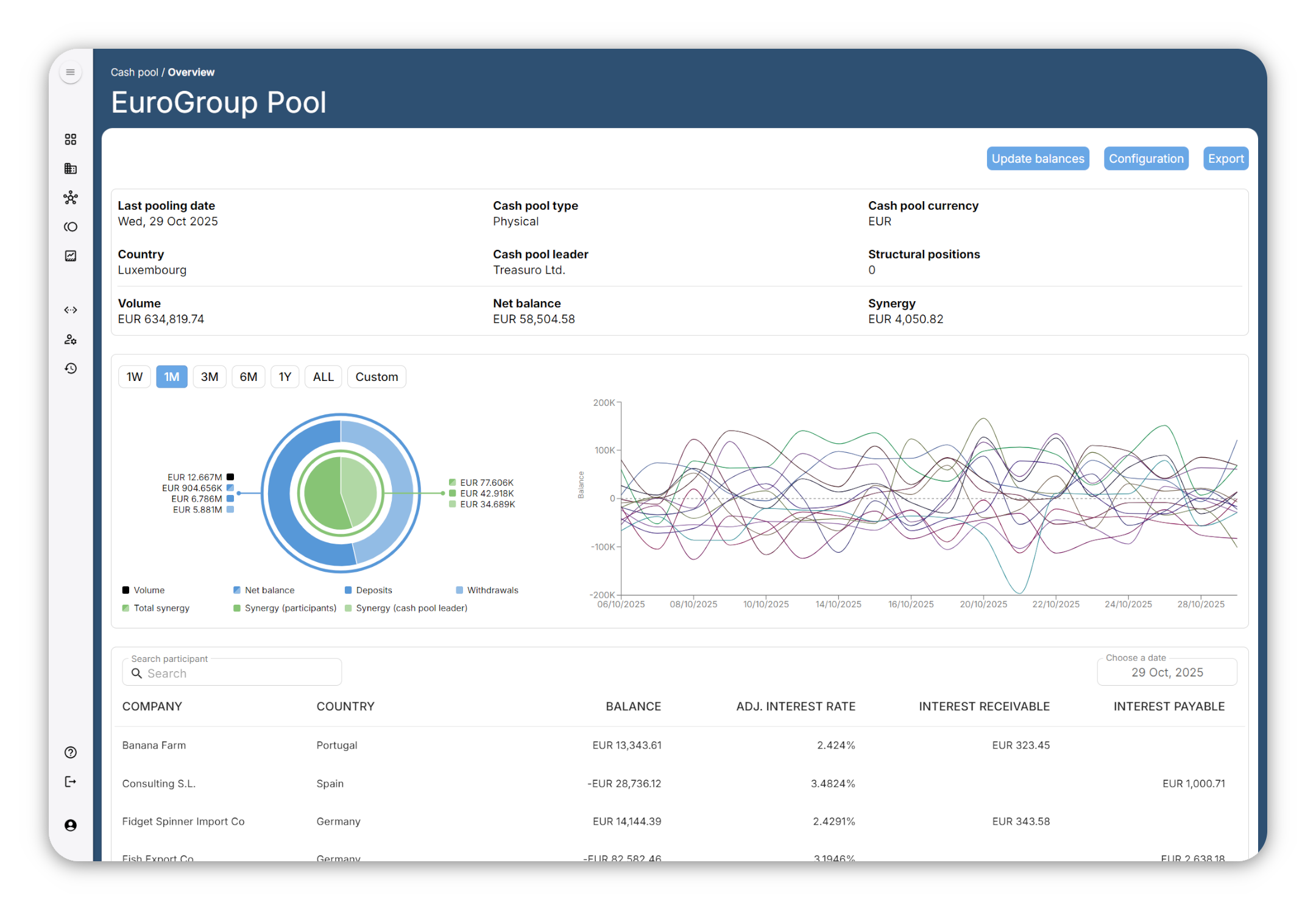
As the synergy benefit created varies with the daily balances, its calculation and allocation should also be performed daily. In practice, this is tedious and, especially for large cash pools, not feasible to do manually. In those cases, we often see the following problematic approaches:
- The synergy benefits are not calculated and therefore fully retained by the cash pool leader. The participants do not benefit from the cash pool arrangement beyond easier access to liquidity. This is difficult to defend and a common cause of scrutiny from tax authorities, as cash pool leaders' roles do not tend to merit such a large remuneration, like in the case of Spain v. Bunge Ibérica. Significant tax adjustments by the authorities are likely.
- The synergy benefits are calculated but not allocated proportionally. In these cases, synergies are usually divided among participants and the cash pool leader without considering their contributions to its creation. This is also not recommended, as tax authorities care about the actual facts and circumstances of cash pools. This will certainly come with the risk of unsubstantiated benefit allocations and thus mispricing the internal interest rates. A transfer pricing audits could uncover this, which may result in significant transfer pricing adjustments, like in the case of Norway v. ConocoPhillips.
For OECD-aligned, consistent, and tax compliant transfer pricing in cash pools, the synergy benefits should generally be calculated and allocated proportionally based on each participant's daily cash pool balances. Multinational groups who do achieve this for their cash pools employ an automation solution that ensures a proper transfer pricing methodology when pricing the participants' cash pool interest rates. Such a solution should ideally also offer automated transfer pricing documentation generation, structural position risk monitoring, and periodic interest settlement calculations. If you are curious about how you can achieve this with Synergen, book an unconditional meeting with us.
Cash Pooling Guarantees
In many cases, banks will require cross-guarantees and rights to set-off between cash pool participants. Paragraph 10.147 of the OECD's guidance acknowledges that, while the specific facts and circumstances of the cash pool should be considered, most cash pools share similarities, such as having various cash pool participants with different standalone credit ratings, and debit and credit positions.
The next paragraph, 10.148, further states that such cross-guarantees and set-off rights do not readily have external comparables because cash pooling does not occur between independent parties. As guarantors, the cash pool participants provide a guarantee for each other but do not control pool membership, the amount of debt they are guaranteeing, and may not even have access to information on the parties for whom they are providing a guarantee. With the lack of actual control over the guaranteed transactions, and other participants guaranteeing the same cash pool positions, the real risk in the event of a default becomes difficult to evaluate.
In practice, cross-guarantees may therefore represent nothing more than an acknowledgement that it would be against the multinational group's interests not to support the performance of the cash pool leader and its participants. In those cases, the level of credit enhancement attributable to the implicit support from other pool participants may be the only benefit a guaranteed borrower may receive, and a guarantee fee would not be justified. The mere existence of legal cross-guarantees does not automatically justify a guarantee fee.
Structural Positions
As part of cash pool transfer pricing policies, one should monitor participants' balances over time. Cash pooling is intended to be a short-term liquidity arrangement, and paragraphs 10.122 and 10.123 therefore describe the need to analyse balances that maintain a debit and credit position for an extended amount of time. Tax authorities may reclassify persistent, structural balances when they exceed what they consider to be a short-term position. This reclassification to a longer-term intra-group loan, separate from the cash pool, would most certainly entail a higher interest rate, resulting in possibly significant tax adjustments. Structural position risk monitoring is thus an important part of operating a cash pool.
Practical Tips for Proper Cash Pool Transfer Pricing
Having covered the essentials of the OECD's Transfer Pricing Guidelines on cash pooling, here are some tips to minimise audit risks and help ensure tax compliance in your cash pool:
- Document cash pooling agreements and guarantees, the transfer pricing methodology, policies, and functions and risks analyses. Make sure that the methodology and policies are clear, consistent, and reflect reality to ensure that interest rates are justifiable.
- Perform regular reviews of participants' credit ratings, as these determine their standalone interest rates and spreads. Credit ratings should generally be reviewed annually, or whenever the relevant facts and circumstances change. Likewise, if the functions and risks assumed by the cash pool leader change materially, its remuneration should be reassessed.
- Manage and foresee risks that may arise within the cash pool by introducing structural position thresholds and forecasting cash flow.
- Automate for higher precision. As cash pool participants' balances change daily, so do the synergies created and the resulting interest rates. With a solution like Synergen, consistent and OECD-aligned synergy-adjusted interest rates and transfer pricing documentation can be produced at the click of a button. Synergen also monitors your cash pool's structural position risks and automates your periodic interest settlement calculations.
If you are considering implementing a group-wide cash pool or already have one in place, a solution like Synergen will bring peace of mind by automating your transfer pricing compliance. Our goal is to enable your teams to focus on strategy rather than tedious compliance calculations to stay in line with OECD Transfer Pricing Guidelines. Get in touch for a quick call to explore whether Synergen is a good fit for you.